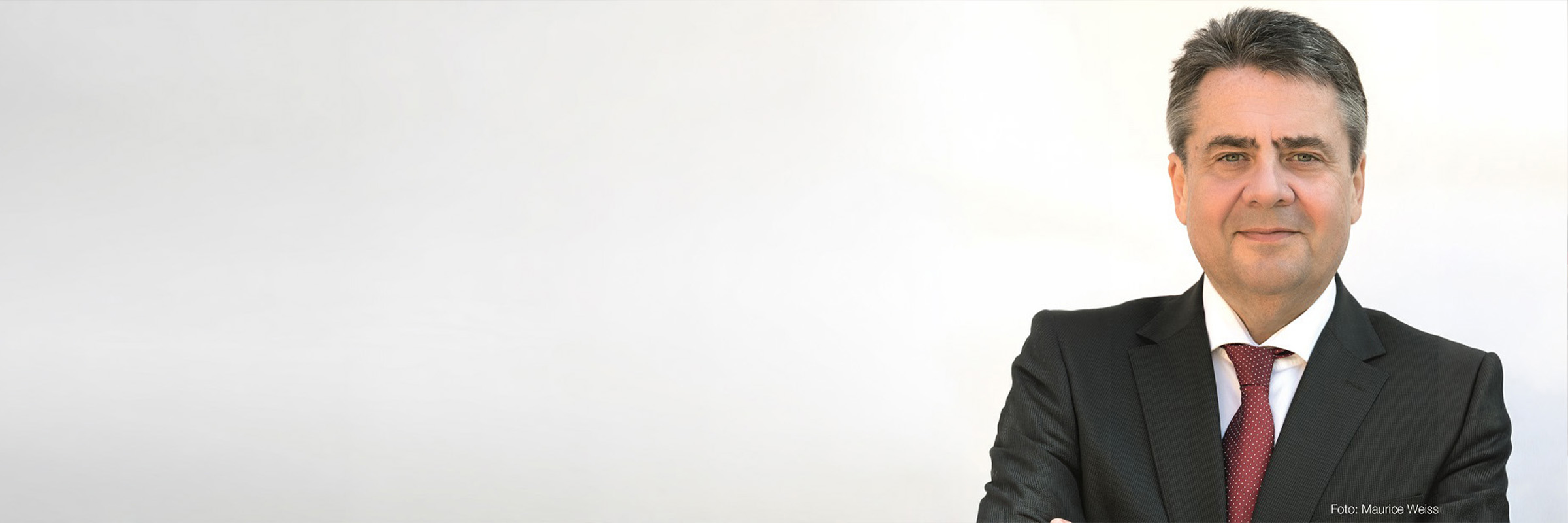
Sigmar Gabriel receives the honorary award of the German Sustainability Award in honor of his political lifes work which brought ecological modernization, industrial strength, social responsibility and international understanding into a connective context.
Sigmar Gabriel receives the honorary award of the German Sustainability Award for concrete political actions, which helped advance climate protection, energy transition, industrial renewal and international responsibility in both Germany and Europe.
Born in 1959 in Goslar, Sigmar Gabriel started his working career as a teacher and adult educator, before politics brought him from a communal mandate to the highest ranking offices of our country. He was Prime Minister of Niedersachsen, a member of the German Bundestag, Federal Minister for the environment, Federal Minister for economy and energy, Foreign Minister, Vice President of the Bundesrepublik Deutschland and head of management for the political party SPD. Today he works as a publicist, consultant and honorary professor at the university of Bonn, as part of the management comittee of the Atlantic-Bridge, in international foreign and security-political networks as well as in directorates and strategic economy gremiums.
The German sustainability Award honors Sigmar Gabriel as a political designer, who did not just describe sustainability within a program, but translated it into political actions. During his time as the federal minister for the environment he belonged to the formative powers behind the Integrative Energy and Climate program of the Bundesregierung. This program combined 29 measures for more energy efficiency, the development of renewabal energy sources, climate friendly buildings, modern cogeneration of heat and power, sustainable mobility and a stronger role in emission trading. It was an important step to loosen climate protection out of single ressorts and instead anchor it as a modernization program for economy and society.
Especially successful was the start of the international climate protection initiative under Sigmar Gabriel. From the release of the emission trade, new programs gained financial backing that allowed investments into energy efficiency and renewabal energy in communes, businesses, centers of education and private households. Climate protection became practical: in schools, town halls, small businesses, accommodations and consumer projects. Sustainability was not just formulated as a practical goal, but connected to support tools, investments and concrete savings.
Gabriel also set important accents on the european and international stage. During the german EU-council presidency and the G8 meeting in 2007, the topics climate protection, energy efficiency and renewabal energy moved into the center of the political ageda. The connection of climate protection, technology, growth and international cooperation became a guiding line which remains influential to this day: industrialized countries need to show that wealth, competitiveness and shrinking emissions can move together if climate politics are to be able to remain competitive worldwide.
As federal minister for economy and energy, Gabriel later took responsibility for the energy transition in an especially difficult phase. Renewable energies had grown strongly, while at the same time the costs, network expansion, market integration and the security of supply became central questions. The EEG-reform in 2014 acted to provide stronger stearing for the expansion of renewable energy, pushed the market integration forward and stabilised the financial basis for the energy transition. This reform was controversial, but politically important: it made very clear that the energy transition did not just rely on the expansion goal, but also on permanent acceptance, the safety of investments and system capability.
With the National Plan of Action for Energy Efficiency, Gabriel also set a focal point on the often underestimated pillar of energy transition. Energy efficiency was understood as an economical chance, as a contribution to supply safety and as low cost climate protection. With that a thought was pulled into the center of attention that would seem self-evident today, but has to be pushed through politically again and again: the cleanest energy is the one that is not being consumed.
Gabriel's accomplishments lie specifically in him leading sustainability in to the sphere of political decisions. He connected climate protection with industrial politics, ecological goals with social acceptance, international responsibility with economic competitiveness. There is no need to share every decision to understand that he put himself into the central strains of sustainable transformation: How can renewable energy stay affordble? How can the industry remain strong? How are investments formed? How can climate goals be translated into rules, markets and institutions?
As the minister of Foreign Affairs and in his present-day functions, Gabriel expanded the view on sustainability to security, democracy, international order and european empowerment. Climate, energy, trade, peace and geopolitical stability are no longer unconnected agendas. Sustainability is also decided on whether democratic societies remain acctionable in an uncertain world.
The German Sustainable Award honors Sigmar Gabriel as a political transformer who made sustainability into something concrete: in climate programs, energy politics, efficiency strategies, european cooperation and in the difficult balance between ecological necessity, economic strength and societal acceptance. He stands for a sustainability that does not remain as a demand, but searches for the way into political reality - to the place where transformation is decided.